Gottfried Stommel lived in Düsseldorf. There is some correspondence with Hans Franck, with editor Cotta and Friedrichtheodor Vischer.
He published some dramas and he completed the Goethe-fragment of “Magic Flute – part two” to an entire opera libretto.
Works Der Weg nach Damaskus (Tragödie) 1908 Gerhart Hauptmanns Legendenspiel in vier Akten “Kaiser Karls Geisel”: Kritik und neuer 4. Akt, 1911 Etwas vom lieben Goll und anderes, was ihr auch nicht wollt 1912 Heinrich von Kleist: Die Familie Schroffenstein (Tragödie, 4. Akt teilweise und 5. Akt von Gottfried Stommel, als Manuskript gedruckt).
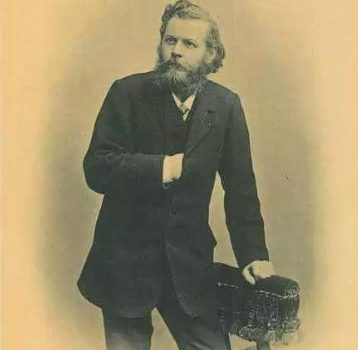
1876 he continued his studies in Weimar and became member of the “Thursday round” of Franz Liszt. 1885 he composed a fairy tale opera Beerenlieschen. He conducted the world premiere in the same year in the Weimar Hoftheater. In 1887 his opera Quintin Messis – der Schmied von Antwerpen, premiered at Weima Hoftheater. From 1909 thru 1927 Goepfart lived and worked in Potsdam.
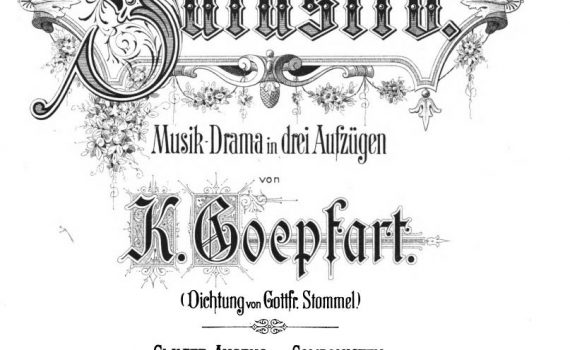
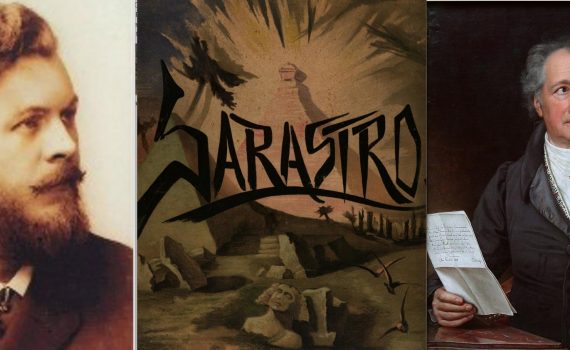
Sarastro. Musik-Drama in drei Aufzügen (Libretto: von Gottfried Stommel und Johann Wolfgang von Goethe) premiered 9th December 1891 concertante in Hengelo.
In 1939 the first scene was given in an event for Goepfart´s 80th birthday in Weimar.
The events of the last decade have pushed many excellent German musicians into the background, unable to assert themselves in the loud and reckless manner so common today. Among these quiet artists is the composer Karl Goepfart, who turned 70 on March 8th and now lives in Weimar. His distinctive male and mixed choirs once carried his name to—one might say—all parts of the world and are still widely heard today. However, this only touches on a small part of Goepfart’s oeuvre. None other than Liszt, with whom the young man studied, recognized Goepfart’s talent for opera and actively promoted it. His first opera, “Quintin messis,” premiered in Weimar at Liszt’s instigation. In addition to a comic opera, “Camilla,” and the musical drama “Sarastro,” a sequel to Mozart’s “The Magic Flute,” G. created a number of successful, genuinely folk-like fairy tales and singspiels, of which, for example, “The Violinist of Gmünd” was performed as a festival play in Gmünd, Swabia, for many years. Furthermore, Goepfart was also extremely active in the field of instrumental composition. He wrote various symphonies, symphonic poems, and a whole series of chamber music works, which, as far as we know, demonstrate a musician in excellent health, far more rooted in Viennese Classicism than Romanticism. This should also be a reason to engage with these works by Goepfart more than has been the case so far. Simply rich, unadulterated instrumental music would be doubly welcome today.
In a letter he writes: “Many thanks for your immediate sending of the queried? reports, which delighted me and my family, mother and siblings. Thank you again a thousand times for that. May the music of ‘Camilla’ give you eloquent acknowledgment, whose sounds were once perceived and described by Master Liszt as ‘remarkably authentically Italian’ [a small musical example follows]. The naturally simple melodic richness of the droll little work resonated in the master’s sensitive and natural ear with an echo from his past youth, something he assured me more than once. The songs and duets of Camilla and [Sarastro?] were his favorite pieces, which I had to play (and have sung) for him very often (still in sketches) at the time. He particularly emphasized the sensual, cheerful vocal element throughout, and with that, he hit the nail on the head, for the opera was born out of the hour. [.]”.
Johann Wolfgang von Goethe[a] (28 August 1749 – 22 March 1832) was a German polymath and writer, who is widely regarded as the greatest and most influential writer in the German language. His work has had a profound and wide-ranging influence on Western literary, political, and philosophical thought from the late 18th century to the present day.[3][4] A poet, playwright, novelist, scientist, statesman, theatre director, and critic;[3]his works include plays, poetry and aesthetic criticism, as well as treatises on botany, anatomy, and color.
Later his fragment was published in 1828 “Der Zauberflöte zweyter Theil“, which has been completed by librettist Gottfried Stommel to this opera.
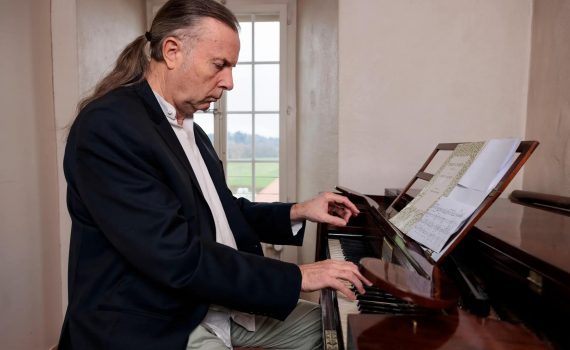
E l l e n b e r g e r, Wolfgang, a fourth students generation after Franz Liszt, digitalized the manuscript partition and the vocal score of the Sarastro opera so that it can be heard probably the first time after 1891 and (partly) 1939, when the first scene was played for the 80th birthday of Goepfart.